- 082 922 4616


Geneticist AT Stud Book / SA Stamboek
Genomic services provided to Small Stock breeds associated with SA Stud Book allows breeders to take the next step in boosting the prediction of an animal’s true genetic merit, ensuring pedigree integrity and unravelling the status of single genes within your flock. Breeders unfamiliar with genomics and genomically enhanced breeding values (GEBVs) must be scratching their heads and wondering what the benefit of genotyping your stud animals truly is. This short article will hopefully illustrate the impact of genotyping an animal, the effect of parentage verification and how genomics is integrated into a genetic evaluation to enhance the accuracy of breeding values.
The Dormer genomic population currently comprises of over 150 animals across over twenty different flocks. Around 30% of the genomic population is comprised of ewes with multiple progeny and daughter records, with some animals born as far back as 2012, contributing to higher genetic diversity within the reference population. Currently, SA Stud Book uses the latest Illumina Ovine60K v3 chip, which contains around 64 000 SNP markers spread across all 26 autosomal chromosomes, the sex chromosomes and a few mitochondrial markers. These include single gene markers, such as the Horn/Poll mutation, the Texel Double-Muscling mutation and the DGAT1 milk quality marker amongst others, resulting in the genomic test being referred to as the “All-in-One” DNA test.
Parentage Verification
The use of DNA Microsatellite markers for Parentage Verification is widespread across the livestock industry in South Africa but has limitations that can result in the incorrect identification of an animal’s parentage. The DNA Microsatellite test is not a true confirmation of parentage, but rather an exclusion of who is not the parent. The low number of markers used (12–25) may result in more than one animal being nominated as the possible sire of the tested progeny, especially if a breeder is using rams that are highly related to each other due to a common ancestor.
Genomics, which is currently the most powerful commercially available tool for parentage verification, uses around 15 000 to 25 000 markers (SNPs) to correctly identify the animals that are directly related to each other. Using a stringent 1% mismatch threshold, this means that a parent will be excluded as the true sire when 150 to 250 markers are not in alignment with the progeny they are tested against. The analysis of opposing homozygotes, illustrated in Table 1, allows for the confirmation that the tested animals are indeed directly related to each other.
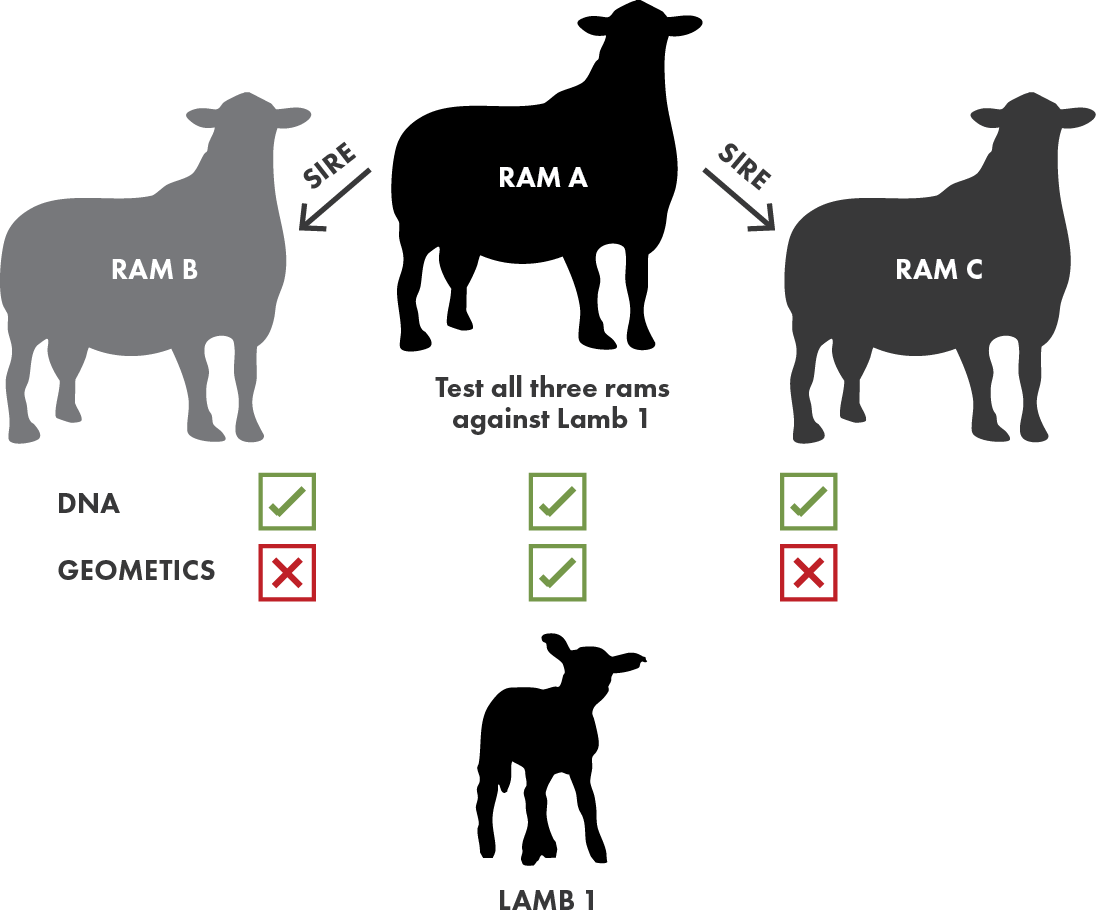

The concept of opposing homozygotes is simply illustrated above, with two sires being tested against Lamb 1. The genomic marker for an animal can only be AA, AB or BB, with the informative marker being the homozygotes or fixed markers (AA or BB). Sire A is a positive match for all four markers as he can only pass on an A marker to his progeny at SNP 1 and SNP 4, and a B marker at SNP 2 and 3. Sire B has 3/4 conflicts as at SNP 1 he can only pass on the B marker, while Lamb 1 is AA meaning he has a mismatch for SNP 1 against Lamb 1. The number of mismatches is added up and if they exceed 1% (150 – 250 markers) this will arise in a sire conflict. Parentage is verified when the number of mismatches is less than 1%.
SA Stud Book is currently the only Data Interpretation Centre on the African continent accredited for Parentage Verification through the International Committee for Animal Recording (ICAR) using Genomic Information. Unfortunately, the genomic data is not backward compatible with DNA Microsatellite data, meaning that in order for Parentage to be verified with genomics, both the parent and the progeny must be genomically tested.
Genetic Relatedness using Genomics.
Apart from accurate parentage verification and knowing the status of specific single-gene mutations, how does genomics benefit the breeder’s ability to more accurately select his top animals? Research on genomics in beef and dairy cattle, as well as small stock breeds, indicates that genomics has the biggest impact on traits that are lowly heritable, sex-limited and are only measured later in life.
The integration of genomic data into a genomic evaluation does one simple thing, it fills in the gaps of the pedigree. The pedigree will at times indicate that animals within the same breed are not related, as breeders may not yet have genetically linked their flocks by using other breeders’ animals, which is known to be a limitation of using simple mendelian inheritance as the pattern of inheritance across generations. Animals within the same breed will be inherently related to each other, as they are the same species (in this case sheep) and of the same breed (Dormer), indicating that they will indeed share a similar genetic makeup. Table 2 showcases how the pedigree matrix uses simple mendelian inheritance to estimate genetic relatedness, while Table 3 showcases the genomic matrix using the 60 000 markers in conjunction with the pedigree matrix, to refine and truly estimate the relatedness between the animals.
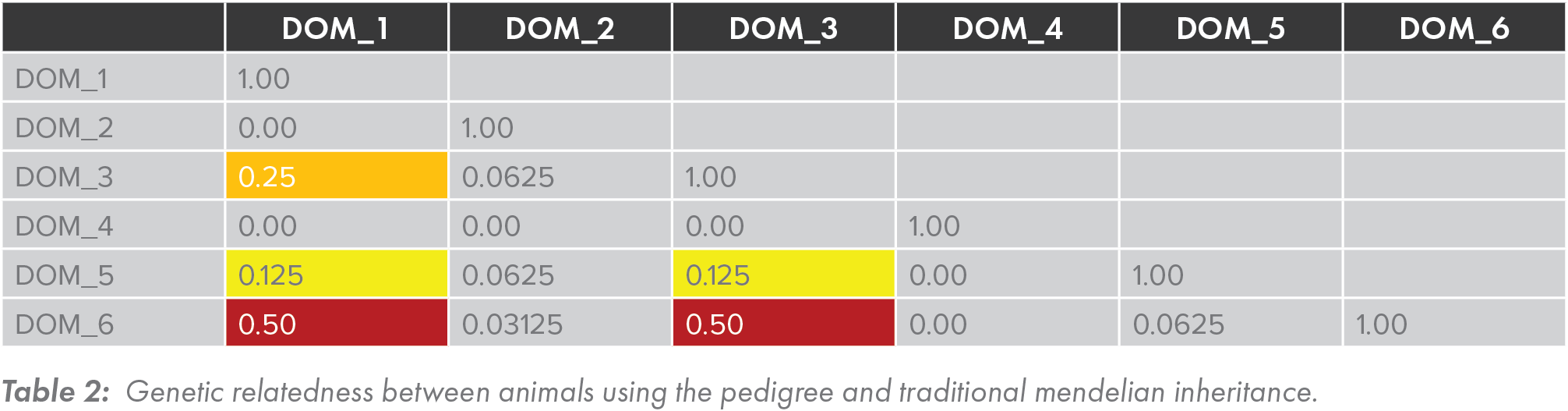
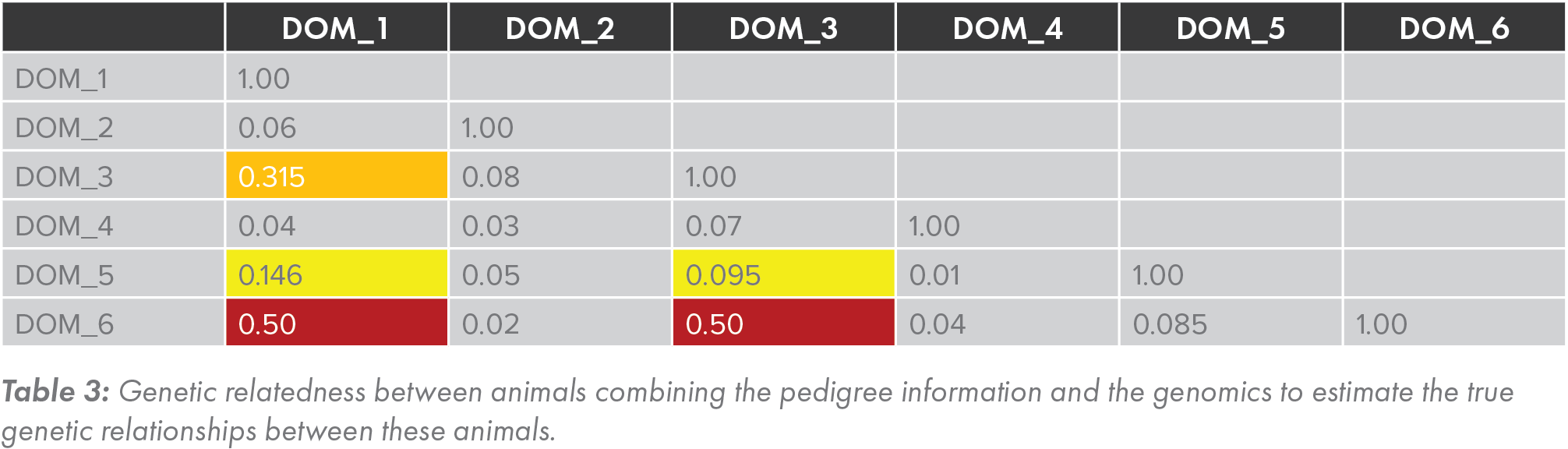
Animal 6 is the Sire of both Animal 1 and 3, which is indicated by the 50% relatedness estimated between them. This makes Animal 1 and 3 half-siblings, meaning that it is assumed they share 25% of the same genetic makeup from the sire’s side. Animal 5 is a close relative to Animals 1 and 3, with the pedigree estimating they are 12.5% related. Animal 4 has no pedigree links to any of the other animals; thus, it is assumed that they are 0% related to the rest of the animals in Table 1.
By comparing Table 2 with Table 3, the genomics has corrected the assumed genetic relationship to a realised genetic relationship. Animals 1 and 3, who are half-siblings, are now indicated to be 31.5% related, meaning they inherited more similar genetics from the sire than was originally assumed. The genomics has revealed that Animal 5 is more related to Animal 1 (14.6%) than to Animal 3 (9.5%). Most importantly, Animal 4 is no longer not linked to the other animals but is between 1% – 7% related to the other animals. Genomics allows the BLUP analysis to make connections between genetically related animals that the traditional pedigrees are unable to make and thus aids in accurately predicting an animal’s genetic potential not just from animals it is directly related to.
The use of genomics is ushering in a new era of stud breeding, especially for breeders who may have closed flocks or are new members of their society. The recording of performance and fertility traits will not be replaced by genomics, as genomics only assists in boosting the pedigree side of the BLUP equation. Phenotype remains King, while Genomics is the Queen the King has always been looking for.